
APA vs. MLA vs. Chicago: A Practical Guide to Citation Styles
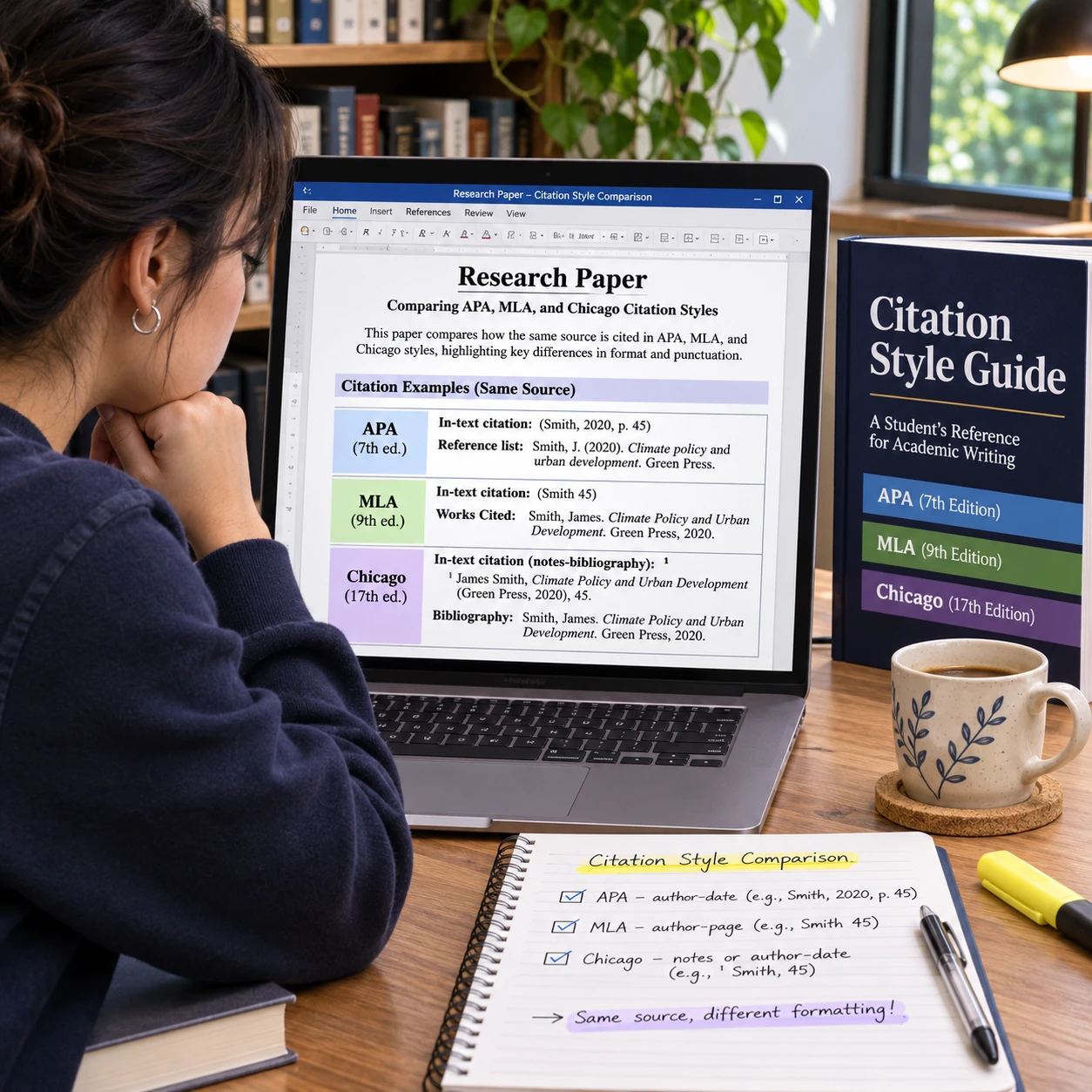
APA, MLA, and Chicago are three widely used citation styles, but they organize source information in different ways. Knowing whether an assignment calls for author-date citations, author-page citations, or notes can help you document research clearly and avoid preventable formatting errors.
Why citation styles matter
Citation styles show where ideas and evidence came from, help readers verify sources, and give credit to other writers. Following the required style also supports academic integrity by making it clear which ideas are yours and which come from research.
A consistent citation system lets readers move from a claim in your essay to the source behind it. That matters when you quote directly, paraphrase, summarize, or use data. A citation does not automatically make a source reliable, but it gives readers enough information to assess it for themselves.
Each style reflects the needs of different academic disciplines. APA places dates near author names, which can help readers see when research was published. MLA emphasizes the author and page number, useful when discussing specific passages in a text. Chicago offers two systems, including notes that can carry source details and additional context.
These formats are related in purpose, but their rules are not interchangeable. Changing only the title of a source list, for example, will not convert an APA paper into MLA or Chicago. Match the citation style to the assignment, then apply its rules throughout.
APA style at a glance
APA Style uses an author-date system: brief in-text citations point readers to a reference list at the end of the paper. It is common in psychology, education, and other social and behavioral sciences.
A typical parenthetical citation gives the author’s surname and publication year, such as (Garcia, 2022). For a direct quotation, include a page number when one is available: (Garcia, 2022, p. 18). The reference list then provides fuller publication details so readers can locate the work.
For example, a book entry generally includes the author, year, title, and publisher. Journal articles also include details such as the journal title, volume, issue, page range, and DOI when available. Exact formatting depends on the source type and the current edition of the Publication Manual of the American Psychological Association.
APA is particularly useful when a source’s date matters to the discussion. Its trade-off is that repeating author and year citations can make a page feel visually busy, especially in research-heavy writing. Keep the details accurate, and do not omit a citation simply because the same author appears nearby unless the applicable guidance permits it.
MLA style at a glance
MLA Style usually uses author-page in-text citations and a Works Cited page. It is widely used in literature, languages, and other humanities fields, where readers often need to find a particular passage in a text.
A basic parenthetical citation may look like (Garcia 18), with the author’s surname and the page number but no comma or publication year. If the author is already named in the sentence, a page number alone may be enough in the parenthesis. The Works Cited entry supplies the source’s publication information.
MLA entries are built around a source’s key details, including its author, title, container, and publication information. A container is the larger work that holds the source, such as a journal, edited collection, or website. This structure helps readers identify sources that appear within larger publications.
MLA’s emphasis on page locations works well for close reading, but it can be less suited to assignments where publication dates are central to evaluating research. Use the edition and guidance specified by your instructor, particularly for online sources, which may not have stable page numbers.
Chicago style at a glance
The Chicago Manual of Style supports two systems: notes and bibliography and author-date. Notes and bibliography is common in history and some arts and humanities fields, while author-date is often used in sciences and social sciences.
In notes and bibliography, a superscript number in the text points to a footnote at the bottom of the page or an endnote at the end of the paper. A note can give source details and, when appropriate, a brief explanation. A bibliography usually lists the sources consulted. For a first citation, a note often contains fuller details; later notes may use a shortened form.
Chicago author-date works more like APA: an in-text citation gives the author and year, and a reference list appears at the end. Because the two Chicago systems differ, “use Chicago” may not be enough information to format a paper correctly. Check whether the instructor expects notes and bibliography or author-date, and follow the requested edition.
Notes provide flexibility for historical context and source commentary, but they require careful numbering and formatting. Author-date citations are more compact, though they may interrupt the flow of prose. Choose only the system required for the assignment.
Key differences between the three styles
The main difference is where each style places source information: APA and Chicago author-date use author and date, MLA uses author and page, and Chicago notes and bibliography uses numbered notes. Their end-of-paper source lists also have different names and rules.
- APA: Author-date citations in the text; a reference list at the end.
- MLA: Author-page citations in the text; a Works Cited page.
- Chicago notes and bibliography: Superscript note numbers linked to footnotes or endnotes; commonly a bibliography.
- Chicago author-date: Author-date citations in the text; a reference list.
A reference list generally includes sources cited in the paper. A Works Cited page lists works cited, using MLA’s conventions. A bibliography may include works cited and, depending on the assignment, other works consulted. Do not assume these labels mean the same thing; follow the style guide and assignment instructions.
Page elements can differ too. APA papers often use a title page and specific heading levels, while MLA papers follow their own heading and first-page conventions. Chicago requirements vary by system and assignment. When comparing examples, check the full paper format as well as the citation punctuation.
How to choose and apply the right style
To choose a citation style, first check the assignment prompt, course syllabus, or department guidelines. If the instructions do not name a style, ask the instructor before drafting; guessing can lead to extensive reformatting later.
- Confirm the style and edition. Write down whether the assignment requires APA, MLA, or Chicago, plus any specified edition or local rules.
- Identify the citation system. For Chicago, confirm notes and bibliography versus author-date.
- Record source details as you research. Save authors, titles, dates, page ranges, publishers, URLs, and DOIs where relevant.
- Cite while drafting. Add citations as you quote or paraphrase, rather than trying to reconstruct source details at the end.
- Cross-check both directions. Confirm that each in-text citation or note matches its full entry, and that every listed source is used as the assignment requires.
Use a current official style guide or library guide for edge cases, such as multiple authors, missing dates, indirect quotations, or unusual source types. A citation generator can help create a first draft, but it may misread a web page or omit required fields. Proofread capitalization, italics, punctuation, author order, and DOI or URL details manually.
Citation support and essay services
Citation support from an essay service may help with formatting or proofreading, but it cannot guarantee accuracy or a particular academic result. If you consider a service, evaluate what it actually provides and check your institution’s rules before using outside assistance.
Reviews of essay services should distinguish between editing, citation formatting, tutoring, and writing work. Those services raise different questions about authorship and permitted assistance. Look for clear descriptions, transparent pricing, privacy practices, and a process for correcting errors; a confident claim of “perfect citations” is not evidence that the work follows your assignment’s requirements.
Keep responsibility for your submission. Verify every citation against the source, make sure quotations and paraphrases are represented honestly, and confirm that the final document follows your instructor’s directions. Citation assistance is most useful as a second check, not a substitute for understanding the style or reviewing the paper yourself.
Frequently asked questions
How do I know which citation style my assignment requires?
Check the assignment prompt, syllabus, course materials, or department guidelines. If the style is not specified, ask your instructor rather than choosing based only on your subject area.
What is the difference between a reference list, Works Cited, and bibliography?
A reference list is used in APA and Chicago author-date and generally records sources cited. Works Cited is MLA’s list of cited sources. A Chicago bibliography may include cited sources and, if required, other works consulted.
Does Chicago style use footnotes or in-text citations?
It can use either. Chicago notes and bibliography uses footnotes or endnotes, while Chicago author-date uses parenthetical author-date citations and a reference list.
Can citation tools replace checking a style guide?
No. Citation tools can save time, but they may produce incomplete or incorrectly formatted entries. Compare their output with current guidance and the assignment instructions before submitting.