
Time Management Tips for Students With Heavy Writing Loads
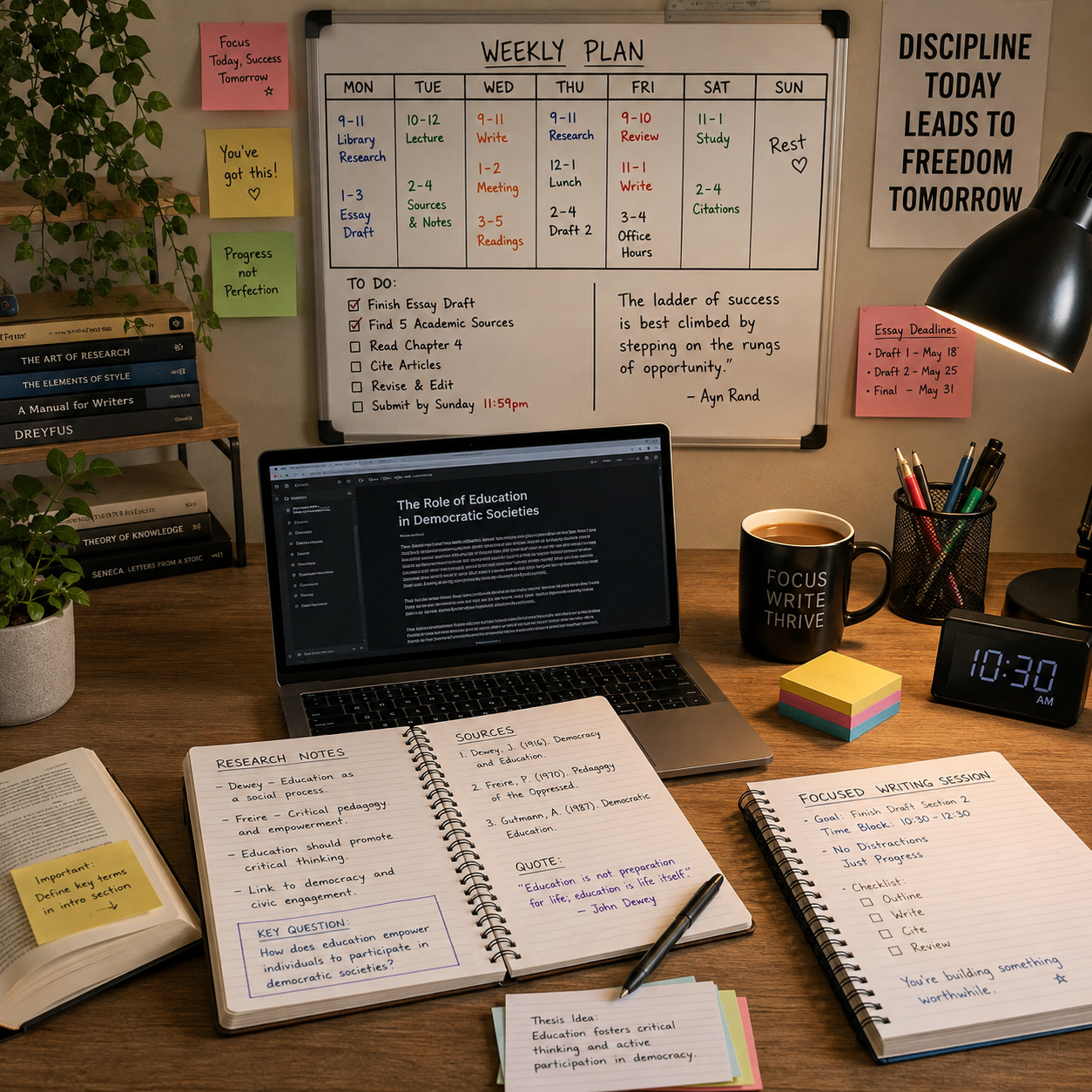
Managing several essays at once requires more than writing quickly. Students also need time for research, outlining, citations, revision, proofreading, classes, sleep, and unexpected academic workload. A reliable system turns a crowded list of assignment deadlines into smaller decisions you can handle each day.
Start With a Complete Assignment Inventory
A complete assignment inventory shows every essay, research task, deadline, and milestone in one place before you create a writing schedule. This prevents smaller tasks from disappearing behind the most urgent paper.
Open a calendar, spreadsheet, or notebook and record each requirement. Include the final submission date, word count, subject, question, citation style, research expectations, and grading criteria. Then add the work that happens before submission:
- Understanding the prompt and choosing a topic
- Finding and reading credible sources
- Creating a working thesis and outline
- Drafting the introduction, body, and conclusion
- Checking citations and the reference list
- Revising, proofreading, and submitting the file correctly
Mark fixed commitments such as lectures, shifts, appointments, and travel. Your available writing time is the space left after essential obligations, not every hour shown on a calendar. Add the date you want to finish each assignment, ideally at least 24 hours before the official deadline. That buffer protects you from technical problems, weak drafts, or a last-minute change in another course.
A useful inventory has three columns for each assignment: deadline, next action, and estimated hours. The next action should be concrete, such as “locate three peer-reviewed sources,” rather than “work on essay.”
Prioritize Essays by Effort, Urgency, and Complexity
Task prioritization works best when you rank essays by deadline, estimated effort, and complexity rather than deadline alone. A short paper due tomorrow may need attention first, while a demanding research project due next week may deserve an early start.
Use a simple risk score to compare assignments:
Priority score = urgency + effort + uncertainty.
Give each factor a score from 1 to 3. Urgency rises as the deadline approaches. Effort reflects word count, reading, data analysis, or citation demands. Uncertainty covers unclear instructions, unfamiliar topics, or difficult sources. An essay scoring 8 or 9 should receive an early planning block even if its deadline is not the closest.
Next, separate tasks into four groups:
- Due soon and difficult: begin immediately and schedule daily progress.
- Due soon and straightforward: complete in focused blocks without allowing it to consume the whole week.
- Later but complex: start research or topic selection early.
- Later and familiar: assign a planned start date instead of repeatedly worrying about it.
Do not confuse visible progress with meaningful progress. Writing 1,000 words for an essay with no clear argument may create more revision work than spending an hour refining the thesis. When several assignment deadlines collide, prioritize the work that reduces future uncertainty.
Turn Each Writing Project Into Smaller Tasks
Breaking an essay into research, outlining, drafting, citation checks, revision, and proofreading makes a heavy writing load easier to schedule. Smaller tasks also provide clear starting points when procrastination makes the full assignment feel overwhelming.
Use this seven-stage workflow for most academic writing projects:
- Decode the prompt: identify the command word, subject, limits, and required evidence.
- Select or narrow the topic: choose a question that fits the word count and available sources.
- Research deliberately: search for sources that answer specific subquestions rather than collecting everything.
- Create an outline: connect the thesis, claims, evidence, analysis, and transitions.
- Draft without constant polishing: write section by section while keeping the argument visible.
- Check citations and formatting: verify in-text references, the bibliography, quotation marks, and style requirements.
- Revise and proofread: improve reasoning first, then clarity, grammar, presentation, and final file details.
Estimate time by stage. For example, a 2,000-word research essay might need two hours for prompt analysis and planning, four hours for research, one hour for outlining, five hours for drafting, three hours for revision, and one hour for proofreading. Your actual numbers will vary, but an estimate is more useful than assuming the paper will take “one evening.”
Keep a visible checklist. Checking off “find two sources on counterargument” gives you a measurable finish line and prevents broad, vague work sessions.
Build a Realistic Weekly Writing Schedule
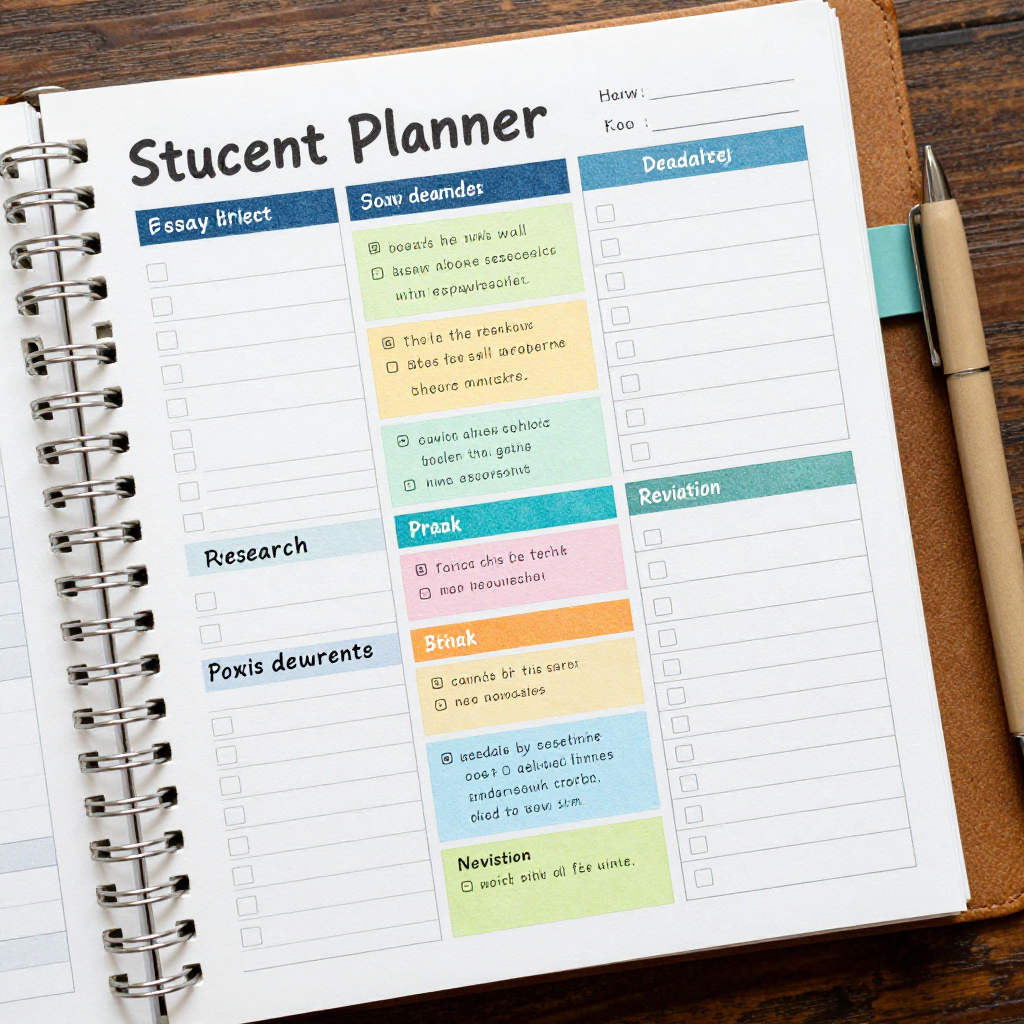
A realistic weekly writing schedule assigns specific tasks to available time blocks while protecting classes, sleep, meals, study breaks, and recovery. It should guide your week without pretending that every day will go exactly as planned.
Start with fixed commitments, then add the highest-risk writing tasks. A three-hour block should rarely contain the label “essay.” Divide it into actions such as:
- 9:00–9:25: review the prompt and select two research questions
- 9:25–10:15: locate and annotate sources
- 10:15–10:30: study break
- 10:30–11:20: build the outline and draft the thesis
Time blocking helps because it converts intention into a place on the calendar. Still, leave at least 15 to 20 percent of your weekly capacity unassigned. That buffer can absorb a longer seminar, a difficult source, illness, or an assignment that requires more revision than expected.
Plan according to energy as well as availability. Put demanding research or argument-building during your strongest concentration period. Reserve lower-energy periods for citation formatting, reading notes, file organization, or proofreading. Choosing a highly detailed schedule improves visibility, but it also reduces flexibility, so use broad blocks when your timetable changes often.
Use Focus Techniques to Prevent Procrastination
Focus techniques reduce procrastination by giving each writing session a defined duration, outcome, and distraction boundary. The Pomodoro technique is one option, but students should adjust the format to the task and their concentration patterns.
A standard Pomodoro cycle uses 25 minutes of work followed by a five-minute break, with a longer break after four cycles. For complex academic writing, 40–50 minutes of work followed by 10 minutes away from the screen may feel more useful. The method matters less than the rule: decide what the session will produce before it begins.
Replace “work on my essay” with a session goal such as:
- Write 250 rough words explaining the second claim.
- Summarize two sources and record their page numbers.
- Compare the draft against the marking rubric.
- Rewrite the paragraph so its evidence directly supports the thesis.
Reduce friction before starting. Put your phone in another room, close unrelated browser tabs, prepare the required readings, and keep a sheet for distracting thoughts. If a new task appears, write it down instead of switching immediately.
Timed work sessions are not a test of discipline. They are a way to make the first step smaller. If 25 minutes feels impossible, begin with 10 minutes of source annotation. The trade-off is that very short sessions may not suit deep analysis, so increase the duration once you have entered the task.
Protect Time for Revision and Quality Checks
Revision and proofreading need protected calendar time because a fast draft is rarely a finished academic paper. Reserve at least one separate session for argument and structure, followed by another pass for language, citations, formatting, and originality.
Use a three-pass quality check:
- Argument pass: Does the thesis answer the prompt? Does every main section advance it? Are counterarguments handled fairly?
- Evidence pass: Does each important claim have appropriate support? Have you explained the evidence instead of simply inserting quotations?
- Presentation pass: Check paragraph clarity, transitions, grammar, citation style, reference entries, word count, file name, and submission instructions.
Read the essay in a different format when possible. Viewing a printed copy or using text-to-speech can reveal repeated words, missing transitions, and awkward sentences that are easy to overlook on the drafting screen. Check quotations against the original source and confirm that paraphrased ideas still have citations.
A common mistake is spending the entire available time drafting and treating proofreading as a five-minute task. The correction is simple: schedule revision before you begin drafting and set an internal deadline earlier than the official one. If time collapses, shorten the drafting target slightly rather than deleting the entire quality-control stage.
When Essay Services Can Fit Into a Busy Study Plan
Essay services can fit into a busy study plan when they provide transparent, permitted academic support such as proofreading, editing, tutoring, or feedback. They should support your learning and independent work, never replace coursework or violate your institution’s academic-integrity rules.
Students reading essay services reviews should evaluate the service as carefully as they evaluate a source. Look for clear information about:
- Service scope: whether the provider offers proofreading, language editing, tutoring, or original assignment writing.
- Academic integrity: whether the terms explain acceptable use and discourage submitting someone else’s work.
- Quality controls: editor qualifications, revision procedures, and how feedback is delivered.
- Pricing clarity: total cost, optional charges, rush fees, and refund conditions.
- Privacy and security: how personal information, drafts, payment data, and uploaded documents are handled.
- Customer support: response times, communication channels, and complaint resolution.
Appropriate support might include a tutor helping you understand an argument, a proofreader identifying recurring grammar problems, or an editor commenting on clarity without rewriting your ideas. Before using any service, check your university or department policy. Requirements differ, and a service’s marketing language does not override your academic rules.
Reviews also require judgment. An anonymous testimonial or a promise of guaranteed grades cannot establish quality. Give more weight to transparent policies, sample editing standards, identifiable support processes, and consistent explanations of what the customer receives. The safest approach is to keep ownership of the research, argument, and final submission.
Frequently Asked Questions
How early should students start a major essay?
Start a major essay at least two to three weeks before the deadline when possible. Use the first days for prompt analysis and research, then schedule outlining, drafting, revision, and proofreading with a 24-hour submission buffer.
How can students manage several essay deadlines at once?
List every assignment deadline, score each paper for urgency, effort, and complexity, and schedule progress on the highest-risk projects first. Keep smaller tasks moving so one deadline does not create a second crisis immediately afterward.
Is time blocking effective for writing assignments?
Time blocking is effective when each block names a specific writing task and includes realistic breaks. It becomes less useful when the calendar is overfilled or when a single block simply says “finish essay.”
What should students look for in essay services reviews?
Look for evidence about service scope, editor qualifications, pricing clarity, privacy, customer support, revision policies, and academic-integrity standards. Treat grade guarantees and unverifiable testimonials as warning signs.
How can students avoid sacrificing revision when they are short on time?
Set an internal deadline before the official submission date and protect a minimum revision block. If necessary, reduce the scope of additional research or polish, but still check the thesis, evidence, citations, structure, and major grammar errors.